
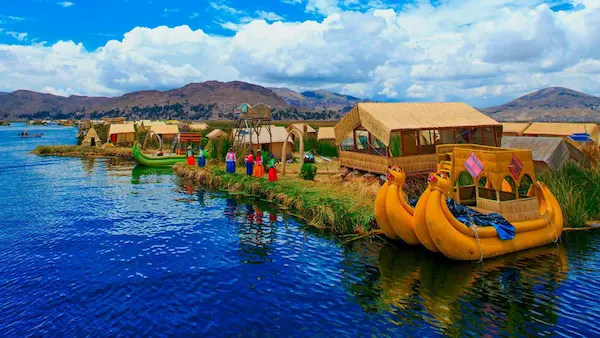
Have you ever hear of the Lake of Titicaca? Sounds a little funny , right? I’ve always been fascinated by Lake. Maybe it’s because of the stories I heard growing up in my village near Puno, or those photos of its endless waters that seem to hide something deeper. Whatever the reason, I’ve come to realize that this place isn’t just a pretty backdrop for photos it holds something more.
There’s a quiet energy there, something that breathes history and mystery. People say there are forgotten temples beneath the surface, ancient ruins that no one has fully uncovered yet. And I’m not talking about grandma’s bedtime stories these are real mysteries that archaeologists have been trying to make sense of for years.
You might be interested in reading: Travel photography in Peru: 15 best places for photographic tourism
What Makes Titicaca So Special?
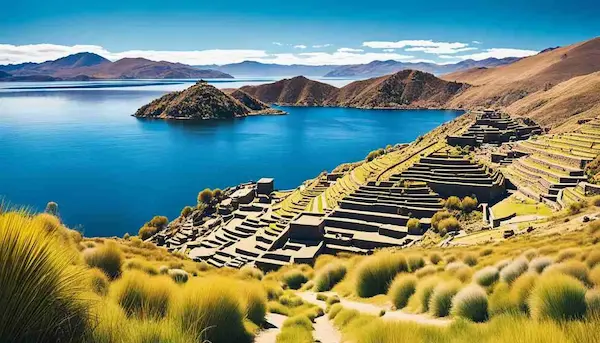
Lake Titicaca isn’t just any body of water. Sitting over 3,800 meters above sea level between Peru and Bolivia, it’s the highest navigable lake in the world. But it’s not just its altitude that makes it unique. It covers more than 8,500 square kilometers, and its waters plunge as deep as 280 meters in some spots. Imagine everything that could be hiding down there. For the cultures that have lived around it, like the Aymara and Quechua, Titicaca has always been sacred. They believe it’s where the god Viracocha, the creator of everything, was born. And it’s not just myth: there’s physical evidence, submerged ruins, proving this lake holds more than what meets the eye.
When I think of Titicaca, I can’t help but picture those floating Uros islands made of totora reeds or the breathtaking views from Taquile. But beyond that, it’s what’s unseen—the mysteries lying beneath the water, waiting to be uncovered. And I’m not exaggerating, because the latest archaeological finds have shaken more than a few experts.
Submerged Ruins: Titicaca’s Lost Treasures
A few years back, in 2000, a team of divers found something incredible at the bottom of Titicaca. It wasn’t just trash or loose rocks, but structures that looked like ancient temples. We’re talking carved stone walls, terraces, and even offerings like ceramics and gold figurines. These submerged ruins sit about 20 meters deep near the Island of the Sun on the Bolivian side, though there are hints on the Peruvian side too. Who built them? Some say it was the Tiwanaku people, a civilization that ruled the area before the Incas. Others think they might be even older.
What blows my mind is that these submerged ruins aren’t a one-off. In 2013, archaeologists found more remains near the Peruvian coast of Titicaca, including a stone path that vanishes underwater. A submerged road? That sounds straight out of an adventure movie. And it’s not just that—there are theories that the lake’s level rose over time, swallowing entire villages and leaving under water what was once on dry land. If you’re into mysteries, Titicaca is a giant puzzle we’re still piecing together.
You might be interested in reading: MrBeast in Peru | The Visit That Surprised Everyone
The Mysteries Titicaca Holds
Talking about Titicaca without mentioning its mysteries is like eating soup without salt—it’s no fun. Beyond the submerged ruins, there are stories passed down through generations. Some fishermen swear they’ve seen strange lights rising from the water at night. Others talk about odd currents they can’t explain, as if something alive is moving down there. Exaggerations? Maybe, but when you add that to the real discoveries, it makes you wonder.
One of the biggest mysteries is the so-called “Temple of Offerings.” It’s said the Incas tossed gold and silver objects into Titicaca as tributes to their gods. In 1968, explorer Jacques Cousteau went down in a submarine and found ceramics and remains, but not the gold everyone hoped for. Yet, in more recent expeditions, items have turned up that confirm Titicaca was a ritual site. What if the treasure’s still there, waiting for someone to find it? Those kinds of questions keep me up at night.
Andean Archaeology: Decoding Titicaca’s Past
Andean archaeology plays a huge role in all this. The experts studying Titicaca aren’t just looking for submerged ruins—they’re trying to connect them to the cultures that lived around the lake. For instance, the Tiwanaku civilization left stunning traces like the Gateway of the Sun, but there’s also evidence they used Titicaca as a ceremonial hub. The items found underwater—ceramics, tools, even human remains—are clues to how these people lived.
What I love most about Andean archaeology is how it flips what we thought we knew. Titicaca used to be seen as just a pretty lake with a few islands, but now we know it was a key spot for trade and religion. The Incas built shrines on the lake’s islands, like Amantaní, and some say those land structures are just the tip of the iceberg. Andean archaeology keeps digging, and every find brings us closer to understanding what really happened at Titicaca thousands of years ago.
You might be interested in reading: DDD Software | The first ally for Tourism Companies in Spain
Exploring Titicaca Today: More Than a Landscape
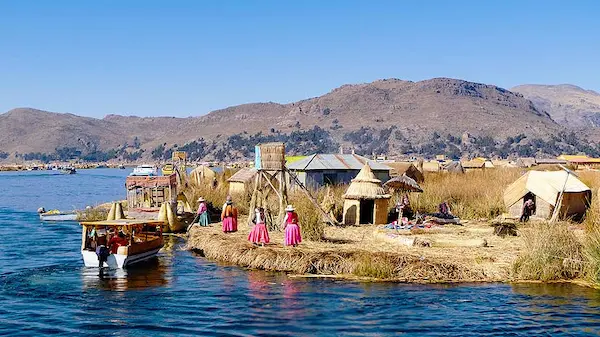
If you ever visit, you won’t just see a stunning lake. Oh no, it’s so much more than that. This place is alive with history, culture, and a kind of magic that hits you the moment you step near its shores. Take the Uros floating islands, for example—they’re absolutely wild. Imagine entire communities living on these man-made islands, built from totora reeds that grow right itself. Houses, boats, even little schools for the kids, all floating on the water like something out of a dream.
I remember my first time seeing them, standing there with my jaw dropped, wondering how people could craft a life so unique out of something as simple as reeds. It’s not just a tourist gimmick either—the Uros people have been doing this for centuries, adapting to the Titicaca’s rhythms in a way that’s hard to wrap your head around.
A Place That Captivates With Every View
Then there’s Taquile, another gem in the Titicaca’s crown. This island isn’t floating, but it’s just as unforgettable. The views from up there are jaw-dropping—endless blue water stretching out to the horizon, framed by the rugged Andes in the distance. But what really gets me about Taquile is the textiles.
The locals weave these intricate, colorful patterns that tell stories of their traditions, and they’ve been at it for generations. Walking through the island, you can feel the weight of history in every step, like the Titicaca itself is whispering its past to you. It’s peaceful, too—there are no cars, just quiet paths and the sound of the wind. If you’re lucky, you might even catch a festival where the music and dance make the whole place come alive.
Adventures That Go Beyond the Ordinary
But if you really want to dig into the heart, a Titicaca Lake Tour is the way to go. These tours take you beyond the postcard spots and into the lesser-known corners that most people miss. One place that sticks with me is Sillustani, a bit off the water but still tied to the Titicaca’s cultural soul. It’s this ancient burial ground with towering stone chullpas—tombs that look like something out of a fantasy novel.
They’re not submerged ruins, sure, but they give you a taste of the incredible heritage that surrounds the lake. Standing there, looking out over the Titicaca in the distance, you can almost feel the connection between the land and the water, like they’re two halves of the same story. A good Titicaca Lake Tour in Peru will weave all these pieces together, showing you how the lake’s beauty and its mysteries are inseparable.
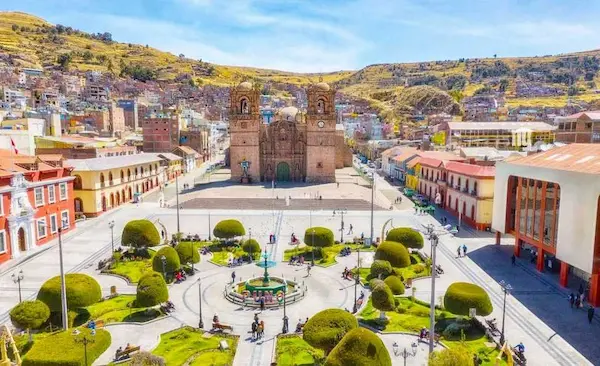
Now, if you’re based in Puno—or even just passing through—Tours in Puno are an awesome way to get up close to the Titicaca’s secrets. There’s a range of options depending on what you’re into. Some focus on the archaeological sites you can reach by land, like the ruins of old villages or ceremonial spots that hint at what life was like thousands of years ago.
These are great if you want to keep your feet dry but still soak in the history. But if you’re like me and the idea of those submerged ruins gets your heart racing, the more adventurous tours are where it’s at. They’ll take you out on boats to the spots where divers have glimpsed those underwater treasures—places where hides its ancient walls and temples. Some even offer diving if you’re brave enough to plunge into the cold, dark water yourself. I haven’t done that yet, but it’s on my list.
An Experience That Stays With You
I won’t sugarcoat it—these experiences aren’t cheap. A solid Titicaca Lake Tour or one of the fancier Tours in Puno in Peru can set you back a decent chunk of cash, especially if you go for the premium ones with expert guides or special equipment. But if you’re into history, adventure, or just the thrill of standing somewhere so ancient it gives you goosebumps, it’s worth every single sol.
I took my family on one a few years back, and it’s still one of those memories that hits me out of nowhere. We started early, the sun just peeking over the horizon, and spent the whole day bouncing between islands and archaeological sites. My kid wouldn’t stop asking about the “underwater cities,” and honestly, I didn’t have all the answers—but that’s the beauty of the Titicaca. It keeps you guessing.
There’s something else I love about exploring the Titicaca today: it’s not just about the past. Sure, the submerged ruins and the mysteries are a huge draw, but the people living there now make it special too. The Uros folks, the Taquile weavers, the fishermen who know the lake like the back of their hand—they’re all part of this living, breathing place.
When you’re out on a boat, cutting through the Titicaca’s glassy surface, you’re not just chasing ghosts of old civilizations. You’re sharing space with a culture that’s still thriving, still tied to the lake in ways most of us can only imagine. That mix of old and new, of mysteries and everyday life, is what makes every trip to the Titicaca feel like an adventure worth having.
What Does the Future Hold for Titicaca?
Titicaca keeps surprising us. Every year, new teams of archaeologists and divers plunge into its waters, hunting for more clues about those submerged ruins and the mysteries around them. Technology’s helping a ton—now they use sonar and underwater drones to map the lakebed. What’ll they find? No one knows for sure, but I’d bet there are more hidden temples waiting to be revealed.
Plus, Andean archaeology is gaining momentum in Peru and Bolivia, meaning more resources to explore. But there’s a downside: climate change and pollution are hitting the lake hard. If we don’t take care of it, we could lose not just its beauty but also the secrets beneath its waters. That worries me, because isn’t just a place—it’s part of our history.
Conclusion
Writing about it really made me realize how much this place means to me. It’s not just a lake it’s an entire world hidden beneath those calm waters. The submerged ruins, the mysteries that remain unsolved, and the Andean archaeology uncovering pieces of the past all pull me in. If you ever have the chance to visit, don’t hesitate. Go for a Titicaca Lake Tour, lose yourself in its islands, and who knows, maybe you’ll feel that special vibe I get whenever I think about it. For now, I’m left wanting to know more because something tells me Titicaca has a lot more stories waiting to be discovered.
